Your Solar Panels Could Affect Your Home Sale
Published October 12, 2026
Your Solar Panels Could Affect Your Home Sale
If your home has solar panels, the system can become an important part of the sale. What matters isn't simply whether you have solar, but how the system was acquired and what financial or contractual obligations may still be connected to it. A solar system may be purchased outright, financed with a solar loan, leased, or provided through a power purchase agreement. Before listing, sellers should locate their solar documents, understand the arrangement, and identify any requirements that may apply when the property is sold.
📝 Introduction
Solar panels are common on many homes, but the financial arrangements behind them can be very different. One homeowner may have purchased the system outright, while another may have a solar loan, lease, or power purchase agreement. Those differences can matter when it's time to sell because a prospective purchaser may want to understand the system, its financial arrangement, and any continuing obligations connected to it. Preparing this information before listing can give sellers more time to answer questions accurately and address potential transaction issues before they become last-minute concerns.
🔑 5 Things Sellers With Solar Should Know Before Listing
1. Know How Your Solar System Is Structured
Solar panels may look similar from one home to another, but the financial arrangements behind them can differ. A system may be purchased outright, financed with a solar loan, leased, or provided through a power purchase agreement. Some solar financing arrangements may also involve a lien or other security interest, which can create additional considerations when selling or refinancing.
Now: Locate your original solar documents and confirm how the system was acquired. Determine whether there are continuing payments, financing, liens, or contractual obligations associated with it.
2. Find Your Solar Documents Early
Solar paperwork can contain information that becomes relevant during a sale, including system ownership, financing terms, warranties, payment obligations, and provisions addressing what happens when the property is sold.
Now: Gather the original agreement, financing or lease documents if applicable, warranty information, installation records, and other available documents related to the system. If you're unsure what happens when you sell, review the agreement and contact the appropriate solar provider or lender.
3. Don't Assume Every Solar Agreement Transfers the Same Way
What happens to a solar agreement when a property is sold depends on the actual contract and financial arrangement. Different agreements can have different transfer, payoff, documentation, or other requirements when the property is sold.
Now: Review the actual agreement and contact the solar provider, lender, or other appropriate company when necessary. Ask what happens when the property is sold, what documentation is required, and whether any remaining financial or contractual obligation needs to be addressed.
4. The Financial Arrangement Can Matter to a Purchaser
A prospective purchaser isn't only evaluating the physical solar panels. The financial arrangement connected to the system can also matter, particularly when payments or contractual obligations remain.
Now: Be prepared to provide accurate information about how your system is structured. Don't assume what a future owner will be required to take over or what must be paid off without reviewing the applicable agreement and confirming the requirements.
5. Understand Payoff and Transfer Requirements Before Listing
If your solar system still has a loan, lease, or power purchase agreement, the sale of the home may involve additional steps. Depending on the agreement, there may be payoff provisions, transfer requirements, fees, documentation, or other conditions that need to be addressed.
Now: Contact the appropriate solar provider or lender before listing and ask what happens if you sell the property. Find out whether the agreement can be transferred, whether a payoff or buyout option applies, what documentation is required, and whether there are any applicable fees or conditions. The answers depend on your specific agreement.
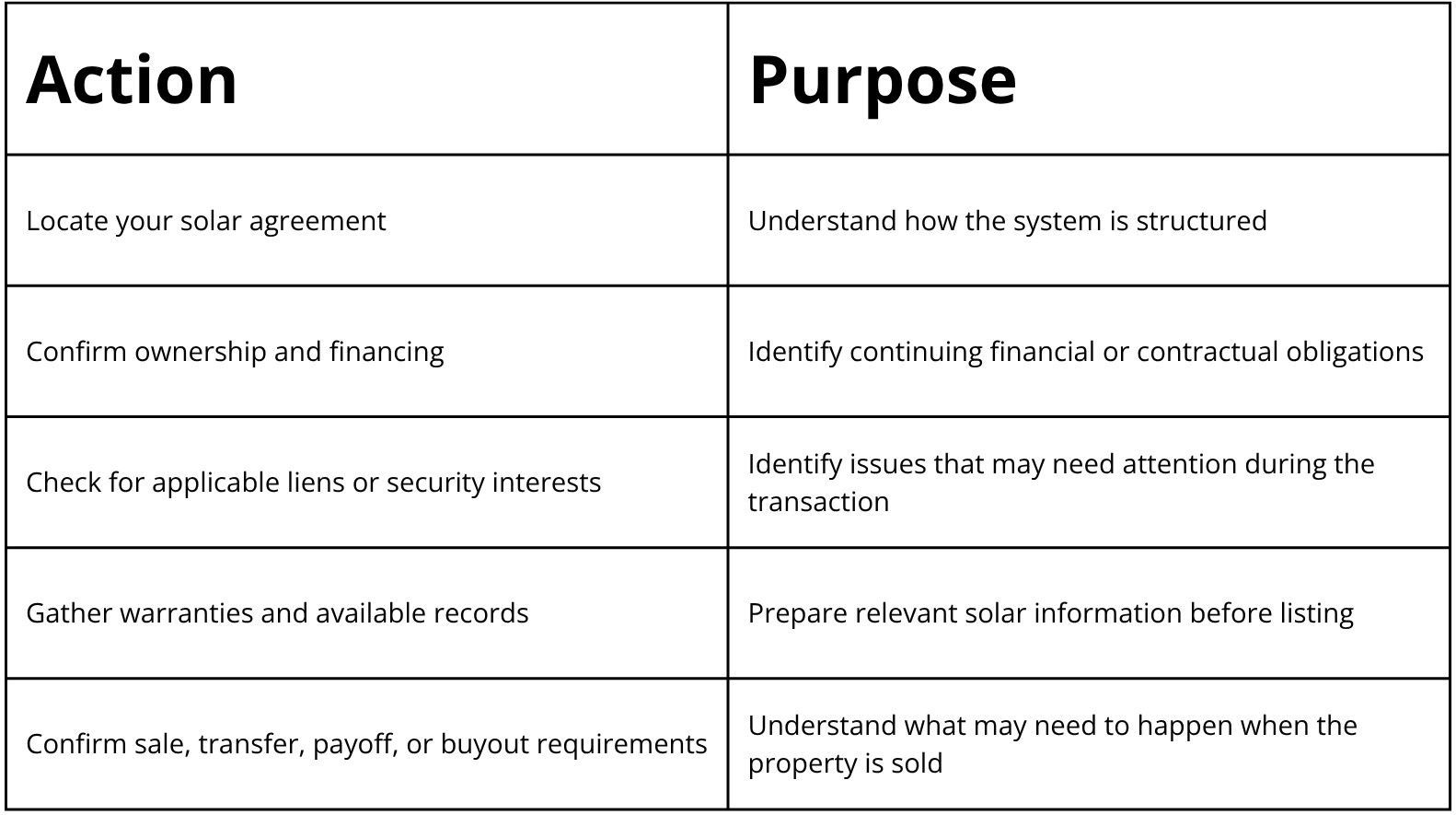
✅ What You Should Do Right Now
❓ FAQ
Q: Does having solar make my home harder to sell?
A: Not necessarily. The circumstances depend on the individual property and solar arrangement. A system purchased outright may present different considerations than a solar loan, lease, or power purchase agreement. Understanding the arrangement before listing can help sellers prepare for questions that may arise during the transaction.
Q: What if I still owe money on my solar system?
A: The answer depends on your financing agreement. Some solar financing arrangements may involve a lien or other security interest, while others may have different requirements. Review your documents and contact the appropriate provider or lender to understand what applies when the property is sold.
Q: Do I have to pay off my solar before selling?
A: Not necessarily. What happens depends on how the solar system was acquired or financed and the terms of the applicable agreement. A system purchased outright, a solar loan, a lease, and a power purchase agreement can each involve different considerations. Review your documents and confirm the requirements with the appropriate provider or lender before making assumptions about a payoff or transfer.
🔚 Conclusion
Solar panels can be an important feature of a home, but when it's time to sell, the financial arrangement behind the system deserves attention too. Whether the system was purchased outright, financed with a solar loan, leased, or provided through a power purchase agreement can affect the questions, documentation, and financial considerations that arise during the transaction. Before listing, locate your paperwork, understand how the system is structured, and confirm any requirements that may apply when the property is sold. Addressing these details early can give you more time to prepare accurate information and handle potential solar-related questions before you're deep into the sale.
This blog is for general informational purposes only and does not constitute legal, tax, accounting, investment, or professional advice. Always consult with qualified professionals before making any decisions based on this content. School information including addresses, phone numbers, and emails was accurate as of the blog’s published date but may change without notice. Please verify directly with the school or institution. This content is provided “as is,” without warranties of any kind. If you are currently under an exclusive agreement with another real estate broker, this blog is not intended as a solicitation.
Contact Us